
About Me
Welcome! I am now a Ph.D student in Geosensing Systems Engineering and Sciences at the University of Houston. My current research focuses on remote sensing of hydrology, with a specific emphasis on flood inundation forecasting. For more information on my research interests and experience, check out my research page!
Education
-
Ph.D. in Geosensing Systems Engineering and Sciences, University of Houston, U.S., Present.
- Advisor: Dr. Hyongki Lee
-
M.Sc. in Communication Engineering, University of Electronic Science and Technology of China, China, 2024.
- Advisor: Dr. Haohao Ren
-
B.Sc. in Communication Engineering, Hefei University, China, 2021.
News
- 2026.10 — I received a computing allocation through NSF’s ACCESS program for my ongoing research on Physics-guided Super Resolution for High Spatiotemporal Surface Water Mapping.
- 2025.12 — I presented my work, Real-time Flood Extent Forecasting Using an Encoder-decoder ConvLSTM Integrated with Data Assimilation, in a Hydrology session at AGU25 in New Orleans. Abstract · Poster
Publications
Journal
Threshold-free Open-set Learning Network for SAR Automatic Target Recognition
IEEE Sensors Journal, 2024. Paper
Conference
Real-time Flood Extent Forecasting Using an Encoder-decoder ConvLSTM Integrated with Data Assimilation
Pseudo-unknown Class Guided-based Open-set Learning Network for SAR Automatic Target Recognition
2024 IEEE International Geoscience and Remote Sensing Symposium. Paper
Layer-wise Representative Exemplar Selection-based Incremental Learning fo SAR Target Recognition
2024 IEEE International Geoscience and Remote Sensing Symposium. Paper
Global-local Information Interactive Learning Network for SAR Target Recognition With Limited Sample
2024 IEEE International Geoscience and Remote Sensing Symposium. Paper
Research Experience
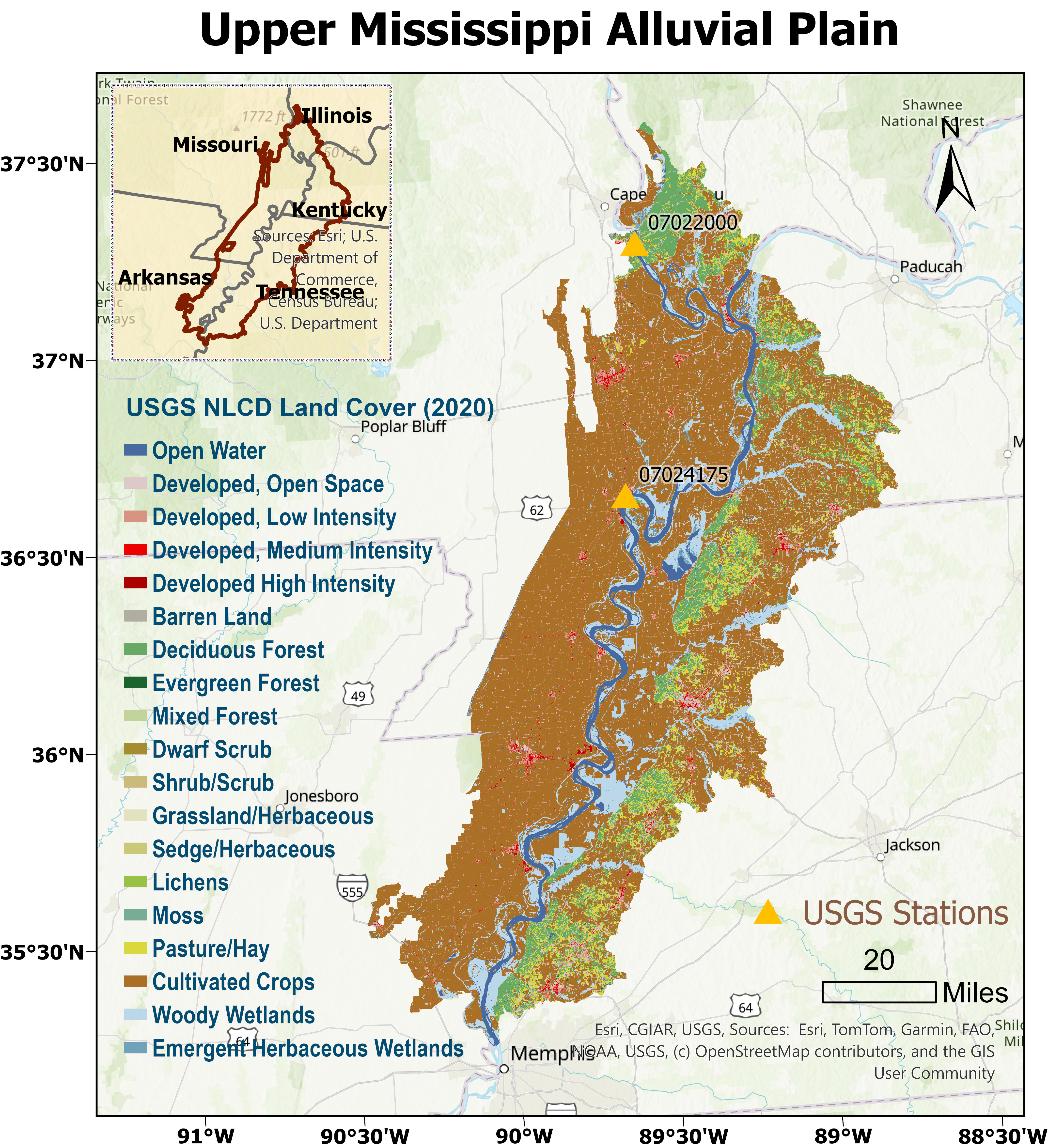
Real-time flood extent forecasting with deep learning and data assimilation
- Combine an encoder-decoder ConvLSTM with Ensemble Kalman Filter (EnKF) data assimilation to forecast flood extent in the Upper Mississippi Alluvial Plain.
- Use VIIRS water fraction observations for 3-day forecasts and reduce error accumulation through satellite observation updates.

Open set recognition based on a hyperspherical embedding network
-
Model extracted features onto a unit hypersphere with von Mises-Fisher (vMF) distribution to improve the inter-class separability of feature representations.
-
Measure the similarity of samples to each class center and design a discrimination criterion to detect unknown targets based on this metric.
-
Calibrate the predicted probability based on uncertainty estimation.
-
Implement the algorithm and evaluate the performance on two public satellite imagery datasets (MSTAR).

A threshold-free open-set recognition network for satellite imagery
-
Propose a threshold-free open-set learning network for satellite target recognition.
-
Improve the network structure of GAN to formulate the open-set recognition problem as a K+1 classification task.
-
Implement the algorithm, evaluate the performance, and compare it with four SOTA models on two public satellite datasets (MSTAR and SAMPLE).
Honors and Awards
- 2022 Outstanding Graduate Student
- 2021 Outstanding Graduate of Anhui Province
- 2019 University Special Prize Scholarship
- 2018 University Special Prize Scholarship